

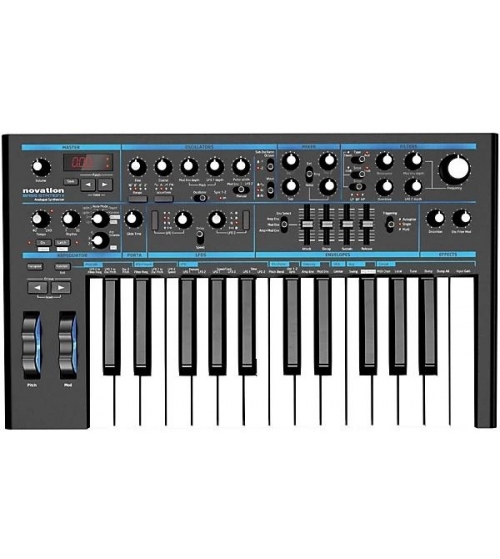
Bass Station II is an analog monosynth with a talent for bass, but a sound engine that is versatile enough to kick out sharp leads and crisp arpeggios. It brings the best elements of the original Bass Station into a brand-new design with reworked modulation, effects, filters and more; like the original, but much much bigger.
The signal path is pure analog—including the effects section. The hardware has been laid out in modules with dedicated pots, switches, sliders and buttons for all major parameters. Critically, you can store and recall patches on Bass Station II. It comes with 64 killer factory presets, space for 64 of your own sounds on the hardware, and the ability to store more on your computer.
The key mechanism consists of 25 full-sized keys that are velocity sensitive with assignable aftertouch. It has been developed as a synth-action keyboard, where each key is individually sprung so it is light to the touch and highly responsive to the synth engine. Bass Station II is a fully class-compliant MIDI device with MIDI I/O on 5-pin din ports—for connecting to other MIDI outboard—and can interface with your computer over USB.
The Synth Engine: A Brief Overview
Oscillators: Bass Station II is built on three analog oscillators and a noise generator. There are two fully independent oscillators plus a sub-oscillator (which is the critical component in creating rich, analog bass sounds). Oscillators One and Two are switchable between sine, sawtooth, square and variable pulse width, and Oscillator Three—the sub Osc—can be set to one or two octaves below Oscillator One. It can be square, sine or narrow pulse width, delivering the characteristically "fat" bass tone.
Filters: You can select between two discrete filters—Acid or Classic—each with a built-in overdrive for pushing filter tones from dry, to warm, to nasty. The Classic Bass Station filter can be switched between low pass, high pass and band pass at 12dB or 24dB slopes. The Acid filter is based on a diode ladder filter design that delivers a characteristically 303-style sound that is designed to squelch.
Effects: Bass Station II has two effects (not including the filter overdrive). Analog distortion drives circuit components to add new frequencies to the sound. Bass Station II's Distortion function can add gentle warmth, filthy granularity and anything in between. The second effect is Osc Filter Mod, which creates a distinctive FM-type sound by using Oscillator Two to modulate the filter frequency. This is very good at crunchy, sound-mulching effects that substantially fatten up bass and lead patches.
Modulation: There are two envelope generators and two low frequency oscillators (LFOs). The first envelope is an ADSR amp envelope and the second is a mod envelope that can be used to modulate filter frequency, oscillator pitch and OSC pulse width. LFO One is dedicated to pitch modulation whereas LFO Two is used to modulate OSC pulse width and filter frequency. Although it looks like there are four LFO waveforms, the LFO Slew function can be used freely to sculpt LFOs into smoother wave shapes.
Arpeggiator and Step Sequencer: Bass Station II's Arpeggiator and Step Sequencer are killer performance and production tools. The Arp can be directed to run through 32 different rhythmic patterns in different directions with a switchable octave range. The fun really starts when you engage the Step Sequencer. Up to four sequences can be played in—with legato and rests—and assigned to any one of the 32 rhythmic patterns. As well as getting ideas down quickly and programming performance sequences, this is a brilliant way to preview patches while you are editing them.
Paraphonic mode
Bass Station II is now a paraphonic monosynth because you can control the pitches of each of the two oscillators separately in its single-voice architecture. Play two notes at a time rather than just one and get interesting interactions through the Ring and Filter Mod.
Filter tracking
Filter tracking was one of your most requested features. The filter includes variable keyboard tracking in Bass Station II v2.5—the best for matching higher notes to increased brightness.
Envelope retriggering
Bass Station II's secret sound-design weapon is envelope retriggering. It’s now possible to configure your envelopes to retrigger once the decay stage has ended, opening up a whole range of new possibilities.
Oscillator error
Oscillator error introduces a small and adjustable random detune on each note-on event. This can be used to generate some very beautiful, subtle (or not) musical dissonance, very much in the same way that vintage synths do (because of the looser tolerance of their electronic components). Paraphonic mode makes it as dramatic as possible.
Microtuning editing
Completely control the frequency triggered by each key press, giving your scales another dimension.
New presets
Two new Soundpacks are in Components: Silver and Sinevibes. Silver's presets explore the v2.5 features and inspire new tracks and sound design. Sinevibes, designed by Sinevibes’ founder Artemij Pavlov, gives 101 classic Bass Station II presets.
Warm greetings to you all
Bass Station II can now support a custom message display at start-up.
The signal path is pure analog—including the effects section. The hardware has been laid out in modules with dedicated pots, switches, sliders and buttons for all major parameters. Critically, you can store and recall patches on Bass Station II. It comes with 64 killer factory presets, space for 64 of your own sounds on the hardware, and the ability to store more on your computer.
The key mechanism consists of 25 full-sized keys that are velocity sensitive with assignable aftertouch. It has been developed as a synth-action keyboard, where each key is individually sprung so it is light to the touch and highly responsive to the synth engine. Bass Station II is a fully class-compliant MIDI device with MIDI I/O on 5-pin din ports—for connecting to other MIDI outboard—and can interface with your computer over USB.
The Synth Engine: A Brief Overview
Oscillators: Bass Station II is built on three analog oscillators and a noise generator. There are two fully independent oscillators plus a sub-oscillator (which is the critical component in creating rich, analog bass sounds). Oscillators One and Two are switchable between sine, sawtooth, square and variable pulse width, and Oscillator Three—the sub Osc—can be set to one or two octaves below Oscillator One. It can be square, sine or narrow pulse width, delivering the characteristically "fat" bass tone.Filters: You can select between two discrete filters—Acid or Classic—each with a built-in overdrive for pushing filter tones from dry, to warm, to nasty. The Classic Bass Station filter can be switched between low pass, high pass and band pass at 12dB or 24dB slopes. The Acid filter is based on a diode ladder filter design that delivers a characteristically 303-style sound that is designed to squelch.
Effects: Bass Station II has two effects (not including the filter overdrive). Analog distortion drives circuit components to add new frequencies to the sound. Bass Station II's Distortion function can add gentle warmth, filthy granularity and anything in between. The second effect is Osc Filter Mod, which creates a distinctive FM-type sound by using Oscillator Two to modulate the filter frequency. This is very good at crunchy, sound-mulching effects that substantially fatten up bass and lead patches.
Modulation: There are two envelope generators and two low frequency oscillators (LFOs). The first envelope is an ADSR amp envelope and the second is a mod envelope that can be used to modulate filter frequency, oscillator pitch and OSC pulse width. LFO One is dedicated to pitch modulation whereas LFO Two is used to modulate OSC pulse width and filter frequency. Although it looks like there are four LFO waveforms, the LFO Slew function can be used freely to sculpt LFOs into smoother wave shapes.
Arpeggiator and Step Sequencer: Bass Station II's Arpeggiator and Step Sequencer are killer performance and production tools. The Arp can be directed to run through 32 different rhythmic patterns in different directions with a switchable octave range. The fun really starts when you engage the Step Sequencer. Up to four sequences can be played in—with legato and rests—and assigned to any one of the 32 rhythmic patterns. As well as getting ideas down quickly and programming performance sequences, this is a brilliant way to preview patches while you are editing them.
Bass Station II v2.5
The v2.5 firmware update adds some of the most requested features including filter tracking, paraphonic mode, microtuning and new preset Soundpacks. Installation couldn't be easier from the Novation Components content manager.Paraphonic mode
Bass Station II is now a paraphonic monosynth because you can control the pitches of each of the two oscillators separately in its single-voice architecture. Play two notes at a time rather than just one and get interesting interactions through the Ring and Filter Mod.
Filter tracking
Filter tracking was one of your most requested features. The filter includes variable keyboard tracking in Bass Station II v2.5—the best for matching higher notes to increased brightness.
Envelope retriggering
Bass Station II's secret sound-design weapon is envelope retriggering. It’s now possible to configure your envelopes to retrigger once the decay stage has ended, opening up a whole range of new possibilities.
Oscillator error
Oscillator error introduces a small and adjustable random detune on each note-on event. This can be used to generate some very beautiful, subtle (or not) musical dissonance, very much in the same way that vintage synths do (because of the looser tolerance of their electronic components). Paraphonic mode makes it as dramatic as possible.
Microtuning editing
Completely control the frequency triggered by each key press, giving your scales another dimension.
New presets
Two new Soundpacks are in Components: Silver and Sinevibes. Silver's presets explore the v2.5 features and inspire new tracks and sound design. Sinevibes, designed by Sinevibes’ founder Artemij Pavlov, gives 101 classic Bass Station II presets.
Warm greetings to you all
Bass Station II can now support a custom message display at start-up.
Features
- Analog synth: brand-new version of the classic Bass Station
- Two distinct analog filters: brand new "Acid" filter joins the "Classic" original Bass Station filter
- Bass Station II ships with 64 factory patches and a further 64 user slots
- Patch dump enables you to archive and swap sounds
- Pattern-based Step Sequencer and Arpeggiator
- Analog synth layout includes dedicated controls for all major parameters
- Two Oscillators plus an additional Sub Oscillator
- Analog effects section: Bass Station II includes fully analog distortion and filter-modulation effects and a separate filter overdrive to add an aggressive, crunchy sound-quality
- Flexible modulation featuring 2 Envelopes and 2 LFOs
- MIDI I/O and USB connectivity
- Players "synth-action" keyboard with aftertouch
- Osc 1
- Osc 2
- Sub Osc (3)
- Noise generator
- Select between waveforms:
- Sine
- Triangle
- sawtooth
- Square/Variable Pulse Width
- Sync 1 & 2
- Detune
- Octave range
- Pitch bend
- Pitch modulation to Mod Envelope and LFO 1
- Pulse width modulation to Mod Envelope and LFO 2
- Select independently between waveforms:
- Sine
- Square
- Narrow pulse
- All modulation and tuning tracked to Osc 1
- Independent octave select
- Osc 1 level
- Osc 2 level
- Sub Osc level
- Noise generator level
- Ring modulation depth
- External signal level
- Two filter types
- Acid type (diode ladder filter design)
- Classic type (derived from original Bass Station)
- Features
- Cutoff
- Resonance
- Overdrive
- Filter frequency to Mod Envelope depth
- Filter frequency to LFO 2 depth
- Select "Classic" filter between:
- Low pass
- Band pass
- High pass
- 12dB slope
- 24dB slope
- Two ADSR Envelopes (Attack/Decay/Sustain/Release)
- Amp Envelope
- Mod Envelope
- Combined control of both Envelopes
- Select triggering mode between:
- Single trigger (holds envelope state when new note is played)
- Multi trigger (retriggers with every new note played)
- Autoglide (engages portamento)
- There is also a VCA limiter
Two LFOs each selectable between:- Triangle
- Sawtooth
- Square
- Sample and hold
- Both LFOs independently adjustable between rate and delay time
- Key sync LFO 1 & 2
- LFO slew on LFO 1& 2 (low pass filter on the LFO waveform)
- Distortion send
- Oscillator filter mod amount (FM effect created by Oscillator 2 modulating filter freq)
- Up to 32 different patterns
- Select between 1-4 octave range
- Swing function
- Select direction:
- Up
- Down
- Up/Down 1
- Up/Down 2
- As played
- Random
- Latch (hold the arpeggiator)
- Up to four sequences
- Assign one of 32 preset rhythms or create your own
- Insert rests or legato (slide)
- Sequencer re-trigger function
- Adjust glide time
- Single trigger or re-trigger modes
- Integrate into step sequencer and arpeggiator
- 25-note synth-action keyboard
- Aftertouch can be assigned to modulate:
- Filter frequency
- LFO 1 to Osc pitch
- Osc 2 speed
- Pitch wheel
- Modulation wheel can be assigned to:
- LFO 2 to filter frequency
- LFO 1 to Osc pitch
- Osc 2 pitch
- Octave up/down buttons
- 64 factory presets
- 64 slots for user patches (and patch dump facility for storing more)
- Master volume dial
- USB MIDI (for connecting & powering Bass Station II via host computer)
- Mono output on 1/4" TRS jack
- Headphone output on 1/4" TRS jack
- External input on 1/4" TRS jack
- Sustain pedal input on 1/4" TS jack
- MIDI IN/MIDI OUT ports on 5-pin din
- DC power input
- Switch between power off/DC powered/bus powered
Specs
Synth Engine
Novation Bass Station II Analog Synthesizer
- Product Code: 1365021482313
Bass Station II is an analog monosynth with a talent for bass, but a sound engine that is versatile enough to kick out sharp leads and crisp arpeggios. It brings the best elements of the original Bass Station into a brand-new design with reworked modulation, effects, filters and more; like the original, but much much bigger.
The signal path is pure analog—including the effects section. The hardware has been laid out in modules with dedicated pots, switches, sliders and buttons for all major parameters. Critically, you can store and recall patches on Bass Station II. It comes with 64 killer factory presets, space for 64 of your own sounds on the hardware, and the ability to store more on your computer.
The key mechanism consists of 25 full-sized keys that are velocity sensitive with assignable aftertouch. It has been developed as a synth-action keyboard, where each key is individually sprung so it is light to the touch and highly responsive to the synth engine. Bass Station II is a fully class-compliant MIDI device with MIDI I/O on 5-pin din ports—for connecting to other MIDI outboard—and can interface with your computer over USB.
The Synth Engine: A Brief Overview
Oscillators: Bass Station II is built on three analog oscillators and a noise generator. There are two fully independent oscillators plus a sub-oscillator (which is the critical component in creating rich, analog bass sounds). Oscillators One and Two are switchable between sine, sawtooth, square and variable pulse width, and Oscillator Three—the sub Osc—can be set to one or two octaves below Oscillator One. It can be square, sine or narrow pulse width, delivering the characteristically "fat" bass tone.
Filters: You can select between two discrete filters—Acid or Classic—each with a built-in overdrive for pushing filter tones from dry, to warm, to nasty. The Classic Bass Station filter can be switched between low pass, high pass and band pass at 12dB or 24dB slopes. The Acid filter is based on a diode ladder filter design that delivers a characteristically 303-style sound that is designed to squelch.
Effects: Bass Station II has two effects (not including the filter overdrive). Analog distortion drives circuit components to add new frequencies to the sound. Bass Station II's Distortion function can add gentle warmth, filthy granularity and anything in between. The second effect is Osc Filter Mod, which creates a distinctive FM-type sound by using Oscillator Two to modulate the filter frequency. This is very good at crunchy, sound-mulching effects that substantially fatten up bass and lead patches.
Modulation: There are two envelope generators and two low frequency oscillators (LFOs). The first envelope is an ADSR amp envelope and the second is a mod envelope that can be used to modulate filter frequency, oscillator pitch and OSC pulse width. LFO One is dedicated to pitch modulation whereas LFO Two is used to modulate OSC pulse width and filter frequency. Although it looks like there are four LFO waveforms, the LFO Slew function can be used freely to sculpt LFOs into smoother wave shapes.
Arpeggiator and Step Sequencer: Bass Station II's Arpeggiator and Step Sequencer are killer performance and production tools. The Arp can be directed to run through 32 different rhythmic patterns in different directions with a switchable octave range. The fun really starts when you engage the Step Sequencer. Up to four sequences can be played in—with legato and rests—and assigned to any one of the 32 rhythmic patterns. As well as getting ideas down quickly and programming performance sequences, this is a brilliant way to preview patches while you are editing them.
Paraphonic mode
Bass Station II is now a paraphonic monosynth because you can control the pitches of each of the two oscillators separately in its single-voice architecture. Play two notes at a time rather than just one and get interesting interactions through the Ring and Filter Mod.
Filter tracking
Filter tracking was one of your most requested features. The filter includes variable keyboard tracking in Bass Station II v2.5—the best for matching higher notes to increased brightness.
Envelope retriggering
Bass Station II's secret sound-design weapon is envelope retriggering. It’s now possible to configure your envelopes to retrigger once the decay stage has ended, opening up a whole range of new possibilities.
Oscillator error
Oscillator error introduces a small and adjustable random detune on each note-on event. This can be used to generate some very beautiful, subtle (or not) musical dissonance, very much in the same way that vintage synths do (because of the looser tolerance of their electronic components). Paraphonic mode makes it as dramatic as possible.
Microtuning editing
Completely control the frequency triggered by each key press, giving your scales another dimension.
New presets
Two new Soundpacks are in Components: Silver and Sinevibes. Silver's presets explore the v2.5 features and inspire new tracks and sound design. Sinevibes, designed by Sinevibes’ founder Artemij Pavlov, gives 101 classic Bass Station II presets.
Warm greetings to you all
Bass Station II can now support a custom message display at start-up.
The signal path is pure analog—including the effects section. The hardware has been laid out in modules with dedicated pots, switches, sliders and buttons for all major parameters. Critically, you can store and recall patches on Bass Station II. It comes with 64 killer factory presets, space for 64 of your own sounds on the hardware, and the ability to store more on your computer.
The key mechanism consists of 25 full-sized keys that are velocity sensitive with assignable aftertouch. It has been developed as a synth-action keyboard, where each key is individually sprung so it is light to the touch and highly responsive to the synth engine. Bass Station II is a fully class-compliant MIDI device with MIDI I/O on 5-pin din ports—for connecting to other MIDI outboard—and can interface with your computer over USB.
The Synth Engine: A Brief Overview
Oscillators: Bass Station II is built on three analog oscillators and a noise generator. There are two fully independent oscillators plus a sub-oscillator (which is the critical component in creating rich, analog bass sounds). Oscillators One and Two are switchable between sine, sawtooth, square and variable pulse width, and Oscillator Three—the sub Osc—can be set to one or two octaves below Oscillator One. It can be square, sine or narrow pulse width, delivering the characteristically "fat" bass tone.Filters: You can select between two discrete filters—Acid or Classic—each with a built-in overdrive for pushing filter tones from dry, to warm, to nasty. The Classic Bass Station filter can be switched between low pass, high pass and band pass at 12dB or 24dB slopes. The Acid filter is based on a diode ladder filter design that delivers a characteristically 303-style sound that is designed to squelch.
Effects: Bass Station II has two effects (not including the filter overdrive). Analog distortion drives circuit components to add new frequencies to the sound. Bass Station II's Distortion function can add gentle warmth, filthy granularity and anything in between. The second effect is Osc Filter Mod, which creates a distinctive FM-type sound by using Oscillator Two to modulate the filter frequency. This is very good at crunchy, sound-mulching effects that substantially fatten up bass and lead patches.
Modulation: There are two envelope generators and two low frequency oscillators (LFOs). The first envelope is an ADSR amp envelope and the second is a mod envelope that can be used to modulate filter frequency, oscillator pitch and OSC pulse width. LFO One is dedicated to pitch modulation whereas LFO Two is used to modulate OSC pulse width and filter frequency. Although it looks like there are four LFO waveforms, the LFO Slew function can be used freely to sculpt LFOs into smoother wave shapes.
Arpeggiator and Step Sequencer: Bass Station II's Arpeggiator and Step Sequencer are killer performance and production tools. The Arp can be directed to run through 32 different rhythmic patterns in different directions with a switchable octave range. The fun really starts when you engage the Step Sequencer. Up to four sequences can be played in—with legato and rests—and assigned to any one of the 32 rhythmic patterns. As well as getting ideas down quickly and programming performance sequences, this is a brilliant way to preview patches while you are editing them.
Bass Station II v2.5
The v2.5 firmware update adds some of the most requested features including filter tracking, paraphonic mode, microtuning and new preset Soundpacks. Installation couldn't be easier from the Novation Components content manager.Paraphonic mode
Bass Station II is now a paraphonic monosynth because you can control the pitches of each of the two oscillators separately in its single-voice architecture. Play two notes at a time rather than just one and get interesting interactions through the Ring and Filter Mod.
Filter tracking
Filter tracking was one of your most requested features. The filter includes variable keyboard tracking in Bass Station II v2.5—the best for matching higher notes to increased brightness.
Envelope retriggering
Bass Station II's secret sound-design weapon is envelope retriggering. It’s now possible to configure your envelopes to retrigger once the decay stage has ended, opening up a whole range of new possibilities.
Oscillator error
Oscillator error introduces a small and adjustable random detune on each note-on event. This can be used to generate some very beautiful, subtle (or not) musical dissonance, very much in the same way that vintage synths do (because of the looser tolerance of their electronic components). Paraphonic mode makes it as dramatic as possible.
Microtuning editing
Completely control the frequency triggered by each key press, giving your scales another dimension.
New presets
Two new Soundpacks are in Components: Silver and Sinevibes. Silver's presets explore the v2.5 features and inspire new tracks and sound design. Sinevibes, designed by Sinevibes’ founder Artemij Pavlov, gives 101 classic Bass Station II presets.
Warm greetings to you all
Bass Station II can now support a custom message display at start-up.
Features
- Analog synth: brand-new version of the classic Bass Station
- Two distinct analog filters: brand new "Acid" filter joins the "Classic" original Bass Station filter
- Bass Station II ships with 64 factory patches and a further 64 user slots
- Patch dump enables you to archive and swap sounds
- Pattern-based Step Sequencer and Arpeggiator
- Analog synth layout includes dedicated controls for all major parameters
- Two Oscillators plus an additional Sub Oscillator
- Analog effects section: Bass Station II includes fully analog distortion and filter-modulation effects and a separate filter overdrive to add an aggressive, crunchy sound-quality
- Flexible modulation featuring 2 Envelopes and 2 LFOs
- MIDI I/O and USB connectivity
- Players "synth-action" keyboard with aftertouch
- Osc 1
- Osc 2
- Sub Osc (3)
- Noise generator
- Select between waveforms:
- Sine
- Triangle
- sawtooth
- Square/Variable Pulse Width
- Sync 1 & 2
- Detune
- Octave range
- Pitch bend
- Pitch modulation to Mod Envelope and LFO 1
- Pulse width modulation to Mod Envelope and LFO 2
- Select independently between waveforms:
- Sine
- Square
- Narrow pulse
- All modulation and tuning tracked to Osc 1
- Independent octave select
- Osc 1 level
- Osc 2 level
- Sub Osc level
- Noise generator level
- Ring modulation depth
- External signal level
- Two filter types
- Acid type (diode ladder filter design)
- Classic type (derived from original Bass Station)
- Features
- Cutoff
- Resonance
- Overdrive
- Filter frequency to Mod Envelope depth
- Filter frequency to LFO 2 depth
- Select "Classic" filter between:
- Low pass
- Band pass
- High pass
- 12dB slope
- 24dB slope
- Two ADSR Envelopes (Attack/Decay/Sustain/Release)
- Amp Envelope
- Mod Envelope
- Combined control of both Envelopes
- Select triggering mode between:
- Single trigger (holds envelope state when new note is played)
- Multi trigger (retriggers with every new note played)
- Autoglide (engages portamento)
- There is also a VCA limiter
Two LFOs each selectable between:- Triangle
- Sawtooth
- Square
- Sample and hold
- Both LFOs independently adjustable between rate and delay time
- Key sync LFO 1 & 2
- LFO slew on LFO 1& 2 (low pass filter on the LFO waveform)
- Distortion send
- Oscillator filter mod amount (FM effect created by Oscillator 2 modulating filter freq)
- Up to 32 different patterns
- Select between 1-4 octave range
- Swing function
- Select direction:
- Up
- Down
- Up/Down 1
- Up/Down 2
- As played
- Random
- Latch (hold the arpeggiator)
- Up to four sequences
- Assign one of 32 preset rhythms or create your own
- Insert rests or legato (slide)
- Sequencer re-trigger function
- Adjust glide time
- Single trigger or re-trigger modes
- Integrate into step sequencer and arpeggiator
- 25-note synth-action keyboard
- Aftertouch can be assigned to modulate:
- Filter frequency
- LFO 1 to Osc pitch
- Osc 2 speed
- Pitch wheel
- Modulation wheel can be assigned to:
- LFO 2 to filter frequency
- LFO 1 to Osc pitch
- Osc 2 pitch
- Octave up/down buttons
- 64 factory presets
- 64 slots for user patches (and patch dump facility for storing more)
- Master volume dial
- USB MIDI (for connecting & powering Bass Station II via host computer)
- Mono output on 1/4" TRS jack
- Headphone output on 1/4" TRS jack
- External input on 1/4" TRS jack
- Sustain pedal input on 1/4" TS jack
- MIDI IN/MIDI OUT ports on 5-pin din
- DC power input
- Switch between power off/DC powered/bus powered
Specs
Synth Engine
- Brand: Novation
- Viewed: 20
- Availability: In Stock
